
The Wreck Diver · Chapter 10
Needle in the red

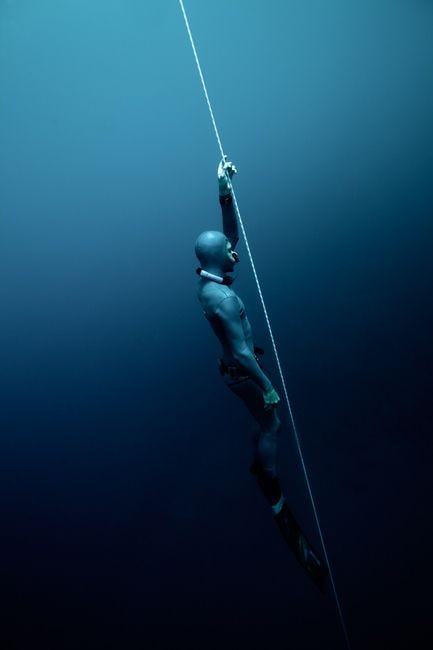
The next dive was in two days’ time, and all dives to the Marie-Caroline would be scheduled, staffed, and authorized by the ministry. James would have two additional divers besides Steph to lead.
One | Two | Three | Four | Five | Six | Seven | Eight | Nine
The French crew boarded their research vessel the morning after the first dive, and we were to join them for a meeting. I felt okay, and Steph was bearing up pretty well. The others had already arrived when we got there, and charts were spread across a stainless steel table, held down by a wrench. The sea was calm. Arnac looked up at us.
—Good morning, he said, no smile.
—Morning. How are you guys doing?
—We are just reviewing a revised Phase One schedule. Come have a look.
I stood over the chart and read it in mounting disbelief.
—If we move to a 1.5 setpoint from twenty-one meters and 1.6 at six meters, we cut twenty-five minutes per profile, possibly thirty, said Arnac.
Stephanie frowned.
—We’re already at 1.3 through ascent, though. Why are we pushing it?
—We are not “pushing.” 1.6 is the accepted decompression ceiling, said Arnac.
Interesting that Aubert didn’t look up from the degradation charts.
—It’s dangerous. No offense, but I was in a coma for three days because of a similar decision, I said.
—The hull’s microbial load is accelerating. The sulfate reducers are active along the starboard seam. If we lose another season to storms, you may be mapping collapse instead of structure, said Aubert in his characteristically neutral tone.
I tried to slow down, and no one else said anything for a moment or two. Then he continued.
—You assume seizure?
—I assume five divers, stacked CNS, and three months of repetition.
—The current schedule is twenty-eight minutes bottom, one hundred ninety runtime, gradient twenty-eighty. CNS per dive averaging sixty-five percent. One recovery day between deep exposures, said the dive inspector.
—What my schedule proposes is bottom time of thirty-two minutes, CNS eighty to ninety percent, but within NOAA exposure tables. As we ascend and pressure drops, oxygen becomes safer to increase. The rebreather can safely maintain a high oxygen pressure, said Arnac.
—Charles, this is like driving a hundred and ten kilometers per hour on a highway designed for a hundred and thirty versus driving 128 kilometers per hour for hours. Both are legal, but one leaves more buffer.
—It is not as reckless as you suppose, James.
—But it removes our margin.
—We are working against time. Gaillard has signed off.
I thought about the prospect of five divers all accumulating central nervous system toxicity. Totally undoable.
—Then, in this case, going forward we do rotated teams, yeah?
He nodded.
The rest of the meeting was about workload and a test bailout strategy at depth. Nothing off there. We left, and Steph suggested we go for a walk to talk about it.
—I understand what they’re trying to do, but I need you to explain the tech stuff to me, James. I want to know what we’re up against.
We were being ferried back to the hotel in a small skiff. When we arrived, we took the path that led to a country lane leading inland. Where to begin...
—Okay. Imagine your body at eighty-five meters is like a sponge soaked in invisible bubbles. Nitrogen. Helium. They have to come out slowly or they form bigger bubbles, right?
—Yeah, but wait, you don’t have to explain the mechanics of a deco to me.
—I know you know, but stay with me for a moment. Oxygen helps flush those bubbles out. The more oxygen we breathe during decompression, the faster the sponge dries.
—Right. More oxygen is good.
—Up to a point. The thing is, too much oxygen becomes toxic. Not gradually either. It can just flip a switch in your brain.
—Ah, okay, yeah. Seizure.
—Right.
—Okay, I understand this, but I need you to explain the CCR setpoints. All this stuff has always been done for me.
—When they say “setpoint 1.5 from twenty-one,” what they mean is this: once we get up to about seventy meters—when we start the long decompression—we tell the rebreather to keep the oxygen level high. Near the top of what’s considered acceptable.
—How high is high?
—Think of it like this. Conservative deco is driving ten kilometers under the speed limit. 1.5 from 21 meters is driving right at the limit for an hour and a half.
1.6 at 6 meters? That’s needle in the red. It’s allowed. But you don’t want to be doing that for three months.
—Shit. Have you ever seen someone hit that line?
—Yeah, a few times. Twitching jaw, tunnel vision, and then it’s not controllable anymore.
She absorbed that.
—But statistically, it’s rare, right? Isn’t that what Arnac meant?
—Sure, but look, statistics don’t mean shit when you’re the one holding someone at twenty feet while they’re locking up, man.
—But if it were reckless, they wouldn’t be asking us to run closer to the ceiling every dive.
—That’s the problem, Steph. On paper, the math allows it.
—Right. In the real dive scenario, it’s unforgiving.
—That’s the exact word. Unforgiving, and at eighty-five meters1.
—What are we going to do?
Really. I had to come up with a counter-proposal and get it in now, today. Before the next dive.
—I’m thinking.
She put her arm around my shoulders. It was the first time I’d ever seen her spooked by something.
We turned around and walked back to the hotel. This was not some little greasy spoon in the sticks. The house was late Victorian, painted a light shade of robin’s egg blue, with yellow June roses climbing their trellises. Like an impressionist painting, a charming bed and breakfast with a small restaurant attached to it. The only thing that broke that image were the expensive cars parked near it. The lunch menu announced itself before we’d even crossed the gate. Steph seemed to have absorbed the shock of what had happened, and I had had twenty more minutes to process while she talked about her apartment in Paris, the Parisians, and a bunch of other things that only required a nod or brief acknowledgment.
We got seated and ordered.
—I know how to fix this, I said.
She smiled, the first good one of the day.
—Of course, you do.
—And they’re going to accept my ideas, because they know what lunacy this is as well as I do.
—First of all, they have to compromise. Like, for example, a higher oxygen pressure at nine meters, not twenty-one, and strict time caps at 1.6. You know, quiet adjustments so that Arnac saves face.
—Exactly, Steph. That’s your head for strategy waking up.
—I’m thinking if they raise setpoints, we add guardrails, and by that I mean that I’m going to insist on off-day HRV tracking for all divers. Have you ever had that?
She nodded.
—Checking the time intervals between heartbeats, yeah. That would be really smart—and in answer to your question: only once. I don’t get to dive this deep usually.
—It’s a good warning system over time, you know? This way if anyone’s benchmark goes below 20 percent variation, they get benched. But apart from that, I was thinking we could unbundle Phase One, not multitask it. CO₂ accumulation depends a lot on workload.
—That’s true. We organize the tasks: high, medium and low CO₂ load. The first ten or twelve dives could just be exterior only, that’s low. And we could cap bottom at twenty-eight minutes.
—If they’ll accept it, I’m going to tell them that only when baseline mapping is complete, do we begin interior work. And then we revert to conservative PPO₂,2 I said.
—Call him. Call Arnac. I’m going to call Robert, but James, he doesn’t need to know about this stuff. Okay? If you talk to him, don’t mention it because he’ll go wild with worry.
She arched an eyebrow.
—Don’t call him. Let’s go down to Marseille. We can have dinner together.
—No. Robert is working. Believe me, I’ve known him for twenty years. When he’s hot on a subject, you can’t pull him away from it.
—Well, okay, then let’s you and me go for a drive or something.
—Alright. Hey, remember that fort we saw in the distance before? Let’s go see what that is, she said, scraping the bottom of her coulant au chocolat.
—Wait, Robert won’t mind if we stay here?
She shook her head and laughed.
—I can ask him point blank if you want, but I already know what he’ll say.
❈
Chapter 11 drops May 13
For comparison, 85 meters is about the same height as the 20th floor of the Empire State building in NYC. Underwater, this is a three-hour decompression ascent.
PPO2 stands for Partial Pressure of Oxygen. It is a measurement used primarily in diving and hyperbaric medicine to determine the pressure exerted by oxygen within a breathing gas mixture, calculated by multiplying the fraction of oxygen (FO2) by the ambient pressure. This value is critical for assessing the risk of oxygen toxicity.
"The Wreck Diver" runs til July 8.