
The Wreck Diver · Chapter 11
Philippe dit Le Fripouille

I might have trouble reconstructing his youth without a true surname because the sobriquet came so much later in his life, but there would be very few Philippes converting to Islam.
One | Two | Three | Four | Five | Six | Seven | Eight | Nine | Ten
The next morning I went straight to the Archives départementales des Bouches-du-Rhône. I was going to concentrate on notarial apprenticeship contracts for ‘Philippe Provençal’ or ‘Philippe du Var’ from 1595 to 1598. There were some digitized notarial indexes going that far back, but for the actual minutes, I’d be sneezing over giant bound volumes with white cotton gloves. It wasn’t necessary anymore to wear them, but hours of touching this stuff dried out my hands. I was amazed that a lot of original documents were still stored in cartons by notary and year. It’s a testament to the quality of the papermaking of that time: long-fibered and slightly alkaline, made from linen or hemp and sized with gelatin, heavier than modern paper. This paper aged slowly and gracefully. Another thing I loved was the penmanship in brown-black ink. Elegantly legible, not like my chicken scratchings.
Once I got over the glory of seeing so much history between my hands, I got down to the task. There were many cartons, and I went through them methodically. Inside the third box, I saw the continuation of something that made my heart leap:
The said Philippe promises obedience, industry, and honest conduct, and to not absent himself without leave, under penalty of forfeiture of wages and lawful correction.
This could be it, but this was marked page two; there was no page one. In the next box I found the continuation, page three, with the signature of a witness:
The said Master Durand promises to instruct him in the said trade and to provide food, lodging, and necessary clothing.
It was frustrating because the first page would have the most important information. I searched all the boxes. It was missing. I asked the clerk, thinking it may have been removed for a specific reason, but he didn’t have any useful information. I hadn’t eaten, and I didn’t care. I would go through all fourteen boxes again. It had to be there. I would start with all the boxes after the one that contained the second page. I found nothing. Then I started with the first twelve boxes, careful to notice if something had slipped inside something else, but it wasn’t in any of them. I returned all but the thirteenth box from 1595, and took the ten boxes from 1596. Nothing. The next day, in the fourth box of 1597, I found a document that started: “L’an mil cinq cent quatre-vingt-dix-sept, le quatorzième jour de mars…”
On the 14th day of March in the year 1597, before me, royal notary in the city of Marseille, personally appears Philippe Le Boutillier, aged approximately eighteen years, native of the diocese of Draguignan, son of Jean Le Boutillier, shepherd, and who voluntarily places himself in the service of Master Antoine Durand, merchant mariner of this port, to learn the trade of sailor, to serve faithfully for the term of three years.
I looked at the page two I had found the day before, and saw that there was no date, which explained how they might have been separated. There it was, the name Antoine Durand. I wanted to whoop and holler, I was so thrilled. This score meant everything. Philippe was real now, not a myth, and I loved how his surname went from Le Boutillier to Le Fripouille. There was a cruel logic to his enemies ridiculing the real surname by mimicking it. I took down the reference numbers, photographed everything, filled out the reproduction forms, and took some phone pictures to send to Steph.
Robert Hines, one, Ravages of Time, zero.
My eyes were dry and blurry. I packed up and headed for the Amista. I needed to swim, then eat. I was going to turn in early because at nine a.m., I would be waiting for the doors to the archive to open.
I dialed Steph.
—Heyyy.
—Hi! I was just going to call you. How did it go today?
—Babe, I found the last name. I still can’t believe it, my God. It took two days, but I found it.
I sent her the photo of page one.
—Oh, wow... That was fast. It could have taken months or years! You’ve always had the luck, Robbie. I’m happy for you. Damn, I should be there for dinner and champagne. I hate it that we’re going to have no time together. Even now, I have to turn in, like, right now. We’re supposed to start at six a.m. tomorrow.
—It’ll keep till the weekend. For now, let’s just imagine the champagne. We’re clinking glasses and getting good and drunk.
—I love that.
—I have to get up early too. What I found today is monumental, but it’s just a drop in the bucket. Today, though... It’s very encouraging, and I’m proving them all wrong, Steph. The material is not scant. It’s here, you just have to know where to look. How about you?
—We’re diving with the full crew now. So far, so good. James is invaluable with the tech stuff, you know? The French guys like him, which is a relief. The work is straightforward. I’ll send you pictures tomorrow. Oh, I want to talk more Robbie, sweetheart, but I have to go. Call me tomorrow around seven, okay? Good night, love.
—Good night, Steph.
I waited for the little pang of sadness to fade. You’d think I’d have gotten used to this by now. Stephanie’s life was so frequently about quick goodbyes and trundling off somewhere. This was her oxygen. How could I resent that part of her nature? Through all the years, all of it, in our airy style, we’d been true to each other in the ways that matter, but there was a certain cost. Some guys have that kind of luck.
I went for a swim. It was sloughing off the dusty centuries and emerging again in the modern world. I dressed and went out to walk along the pier, feeling clean and relaxed. After dinner, I bought an ice cream and walked. In a little square, under the trees, there were performers. Young kids doing acrobatics to the hottest rappers in the city, 13 Organisé. I only knew about them because you couldn’t go anywhere without seeing posters for their gigs, and their music was like a spice added to the melting pot. It poured out of the pizzerias, kebab shops and clothing stores. The kids were good, sinewy and strong, disciplined, unfazed by falls or fluffed moves. I don’t know what made me feel older, them, or the fact that I could barely keep my eyes open. I was revisited by the soft elation of my day’s work. Time to go back to the hotel.
I woke the next morning in good spirits. Before even getting out of bed, I knew what had to come next. There were now two parallel archival arteries to follow. I would continue with as much of the follow up on Le Boutillier as I could, and in parallel, start one on Antoine Durand. First question: if Antoine Durand was a merchant mariner in late 16th-century Marseille, what categories of records could realistically survive and mention Philippe? Thank god for notaries and the scrupulous conservation habits of the French. Besides the contract I found, there would be all kinds of things: wage agreements or disputes, crew rolls attached to voyage contracts, cargo manifests, even disciplinary fines. I could add a third category to my search terms: ‘Philippe Le Boutillier, matelot.’ My only problem now was that the volume of documents had exploded, so the search would go much slower.
I found that Durand was not wealthy but had a stable trade, paid his bills and the crew rolls didn’t show a lot of turnover in those three years. He traveled to Genoa and North Africa, specifically Tunis. Steph and James had done four dives before I found anything useful, and I was kicking myself, because it was in a box I had already searched twice for information about Durand. I mean, I literally passed right over the next key to unlocking the second phase of Philippe’s short life. It was forgivable though. Just a small list of apprentices with Philippe’s name crossed out and a note that said: deserté. My backward search was intact, but my forward search had just been snuffed out. Or had it? Like a ship at sea, I’d have to tack. I looked for Port discipline registers, and the motherlode was suddenly in my possession. I found many citations, scads of them, for drunkenness, dock brawls and jailings, but all in the name Philippe Le Boutillier, matelot. Up to now there had been no mention of the sobriquet, even though his behavior was routinely disorderly. Now for the first time he was listed as ‘Philippe dit Le Fripouille.’
Steph and James had done four dives before I found a crew roll with his name again. This was a ship that traded cloth, and farming implements. It would bring back grains, olive oil, and beeswax. Its owner lived in Marseille, but his name was Fares Charrat, another exciting find. ‘Fares’ was North African; Charrat, though it sounded French, was Berber. Further investigation proved it was Mozabite, the Berber inhabitants of the Sahara.
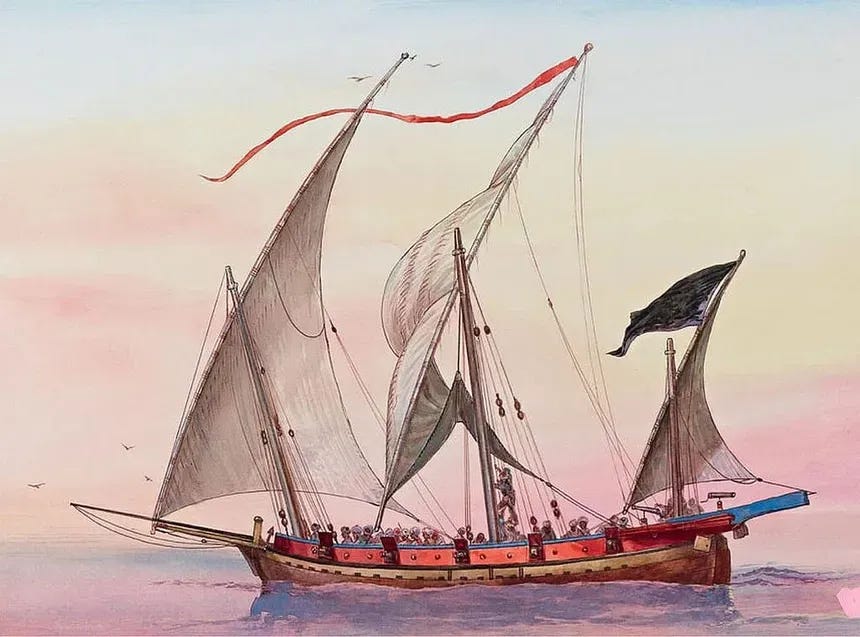
I repeated the same search as for Durand. Voyages, crew rolls, cargo manifests for Charrat, and here I found tragedy. The xebec Al-amal al-salih, the Good Hope, had been attacked by corsairs on its way to Algiers on May 12, 1599. All goods and crew had been lost. There was also a petition from Mr. Fares Charrat dated a few weeks later stating losses as ‘pris par les corsairs d’Alger.‘ There was a list of lost goods, and the dead and missing crew. Next to Philippe Le Boutillier was the word ‘disparu,’ so at this point, I would have to check for records of municipal ransom funds. If I did not find his name among the ransom records, this would point in a telling direction.
❈
Chapter 12 drops May 20