
The Wreck Diver · Chapter 13
Madrid

Once I got over the glory of seeing so much history between my hands, I got down to the task. There were many cartons, and I went through them methodically.
One | Two | Three | Four | Five | Six | Seven | Eight | Nine | Ten | Eleven | Twelve
The wreck had been provisionally identified years ago. I had already written about the French hull construction, the cargo pattern was consistent with a late sixteenth-century merchant vessel, and only one ship of that type was recorded lost in those waters at the time. James’s wood specimen had done a lot to support the conclusion that it was the Marie-Caroline. This was one of the most challenging historical puzzles I’d ever had to figure out. The first thing working against me was the incompleteness of the record. I was working without a captain’s log or cargo manifest, and the insurance records had been destroyed in a fire in 1612. This much I had ascertained. But that trail had petered out. How do you continue when the archive around a shipwreck is thin? My answer was to reconstruct the people who made the thing happen.
I knew La Fripouille was hung for seizing a merchant ship, but the records didn’t explain how a shepherd’s son from Provence could turn into a man capable of becoming a pirate. Now that I had some key facts about him, I was not about to let myself meet with another dead end. The man had disappeared. I needed to find out if he’d been kidnapped, and if so, whether he’d been sold into slavery in Algiers or ransomed. I would look for ransom documentation, although honestly, by now, who would have wanted to redeem Philippe La Fripouille? Good riddance would have been a more likely reaction to his kidnapping. Therefore I prioritized captivity notifications. If Philippe survived the corsair attack, his name might appear on a captives’ roster sent back to European ports, and the best place to find those was at the Biblioteca Nacional in Madrid.
My plane touched down in Barajas. After calling a longtime colleague of mine, Carolina Jiménez, I took a taxi to Paseo de Recoletos. I knew Carolina from a symposium we had both spoken at about ten years prior to my taking the job I currently held in North Carolina. She was pleased to hear I was in Madrid and said she’d meet me for dinner that night. I had booked a hotel for just one night, gambling that I wouldn’t need more than two days. My backup plan was the Archivo Histórico Nacional in Madrid, and if I found nothing there, the BnF in Paris.
Fortunately, captive notifications circulated widely. I could find captivity reports involving the Mediterranean, especially lists of captives taken by Barbary corsairs, and consular correspondence. Having the date of his disappearance was important. There were three tomes the size of an old-fashioned atlas for that year. I knew it was 1599, but not the month, so I would have to go through all of them. I would look first in the May–August, then January to April, skipping January and February, and lastly September to December. Logical but totally wrong. On the second day, I was pissed that I hadn’t looked at this tome second, but I was convinced it would have been in the spring, when the Mistral is strongest. When I found the entry I clasped my hands in surprise.
Felipe Lebutillier, marinero, natural de Draguiñán (Provenza), cautivo por corsarios de Argel, el 7 de septiembre, de 1599.
Kidnapped by Algerian corsairs. But there was more. I found an untranslated bundle of consular correspondence with the one document that made my trip to Madrid worth the trouble:
L’an mil cinq cent quatre-vingt-dix-neuf, au mois de novembre, Avis est donné concernant un marin captif nommé Philippe Le Boutillier, natif du diocèse de Draguignan en Provence, pris par des corsaires lors de l’attaque d’un navire marchand en route vers Alger. Notification envoyée à Jean Le Boutillier, berger de ladite paroisse, père du captif. Ledit Jean Le Boutillier déclare n’avoir ni obligation ni volonté de contribuer à la rançon dudit Philippe. Affaire classée sans suite.
Affaire classée sans suite. Sans suite. Case closed.
—Oh, God.
Between my hands was proof that Jean Le Boutillier had been notified of the ransom and had refused it. Philippe’s father had abandoned his first-born son to the wolves. I sat for a moment, rather dazed by this discovery. I was trying to imagine what it would feel like to be cut off from one’s family and one’s past so definitively. Not just the pain of it, but the impetus it must have given him to step across a threshold. It would have been the death of his old self. In my research, I had uncovered the many brutal atrocities committed by this man later in life, blanched at the viciousness of them. With this ordinary bureaucratic document, I suddenly had the man’s deeper story, and a clear path to the next milestone: the Bibliothèque Nationale d’Algérie.
Phone calls were in order—an appointment at the Algerian Embassy for the next day, a new reservation with Air Algérie, and a flight change for my current itinerary. Then I called Carolina.
—Diga, she said.
—Hi, Caro. It’s Robert Hines. I’m done for the day. I’ll be heading out of the Archive right now. Shall we meet somewhere?
—Hola, Roberto! Yes, that will be great. Let’s meet in La Latina. Plaza de la Cebada—in an hour?
—Great. See you soon.
The heat had died down, and it wasn't too late to walk part of the way back to my hotel. The Paseo del Prado is a tree-lined boulevard in the center of Madrid, flanked by fountains and pleasant gardens. When I got to the Plaza de Cibeles, I noticed the tourists way up at the top of the Correos building, from where you could see all the way to the Sierra de Madrid. I had no idea they had turned the upper floor into a lookout point, and Steph hadn't been back to Madrid since our trip, so I took a few shots of it and sent them to her. I knew she'd ask if we could return here together. My text message was brief: In Madrid. I'll be back by the end of the week. Call you later. Then I turned onto the Gran Vía, and with the sun in my eyes, hailed a cab back to the hotel.
—El Barceló Torre, por favor.
Traffic was heavy and loud, but we made it there in time for me to shower and change. Then another taxi to the meeting point. Carolina was waiting in front of a restaurant I remembered from my first trip to Madrid. We greeted each other and kissed on each cheek.
—Are we eating at El Viajero?
—The food is not bad, but at this hour...I think no.
—Too crowded?
She wrinkled her nose and laughed.
—Una matraca insoportable. We would have to shout to hear each other! I have something better in mind, en la Cava Baja.
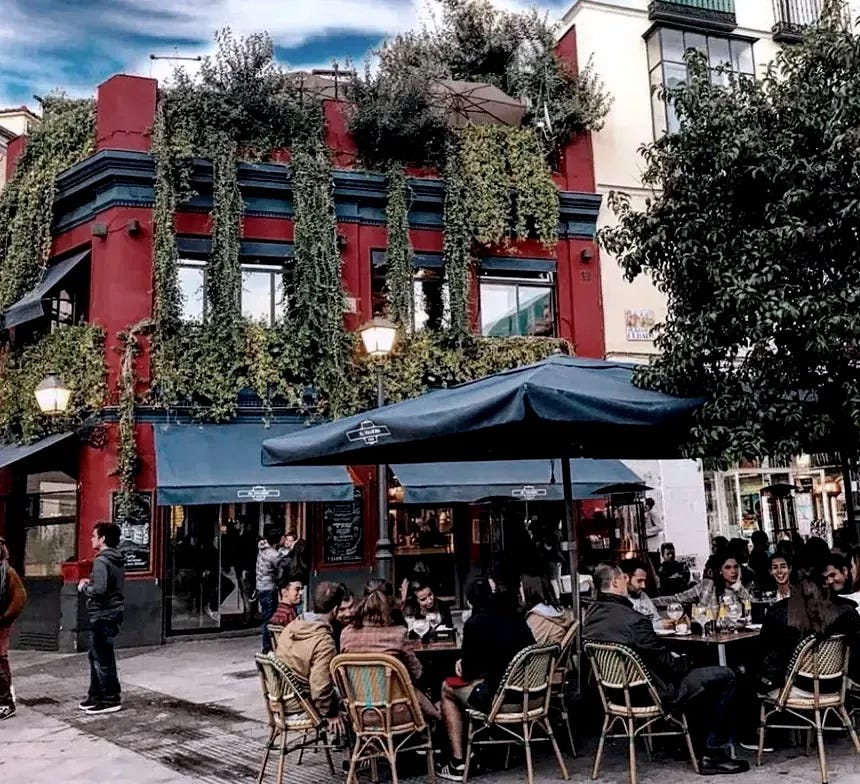
We walked down a narrow cobblestone street lined with restaurants of all kinds, and went into a place that was just opening for business, which was fine because we did not have reservations. Through some crazy luck we got a table at Casa Lucas.
I ordered wine and we caught up on news from the intervening years since 2018. She had secured a place in the history department of the Complutense, but life had become difficult for university professors. We compared notes, and she kept her highly justifiable rant down to just a few comments because during the same time she’d published a book. My research dominated the rest of the conversation since she was full of questions about it.
When the food came, I sat staring at it.
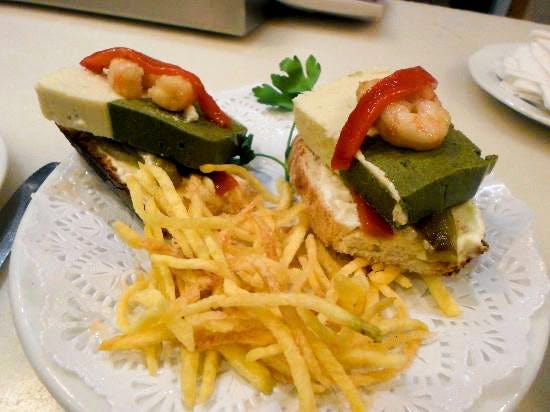
—Wait, is this right? I ordered ‘Pastel de espinacas y puerros con gambas.’ That’s spinach and leek pie with shrimp, isn’t it?
—Claro, look, she said, pointing to the green and white bar that looked more like a slice of pâté or spumoni.
—Oh, right!
I was put off by the presentation, but when I tasted it, my confusion melted away with the flavors. Her order was less deceptive. She offered me a bite, and it was delicious. While we ate, I could hear someone playing the slot machine in the bar next door. These were all over Madrid. When someone won, there would be the sound effect of bells to go with the flashing lights, and a male voice saying, ‘PREMIO!’ (prize) Then the real sound of euros cascading into the coin return tray.
Carolina asked after Stephanie, and was pleased that we were working together on this project. Thrilled by my pirate story, she asked lots of questions.
—So where do you go now? Back to Marsella?
I explained that the next stage of Philippe’s life had unfolded in Algiers, and that I would have to go there. Her eyes widened.
—Qué maravilla.
—Well, I hope it’s marvelous. Algiers is not always so easy to navigate. This starts tomorrow with the embassy, where I must get the visa—and it’s a bit pricey.
I wondered if I would encounter the same impossible functionary as the last time.
—You’ll do fine, Robert. I see the fire in your eyes when you talk about this Philippe.
Our plates were taken away, and the server brought two shot glasses and a bottle of licor de hierbas, a sweet digestif. It was bright yellow, and my eyes popped when I saw the label.
—Hijoputa1?
Carolina laughed.
—It’s not an insult! It comes from an Asturian expression: ‘¡Qué bueno, el hijoputa!2’
I was going to knock it back, but she touched my arm.
—Not like that. It’s not like a shot of vodka; you sip it.
—What’s in it?
—It’s made of anis and fennel, rosemary, I think, and a lot of other things. Canela… What’s the word for that? I forget.
—Cinnamon.
I took a sip. Not bad.
The server placed a silver tray with the check on it.
—My treat, I said.
After dinner, we took a lovely walk through Lavapiés and down to Atocha Station. I was already mentally planning what I would work on when I got to the hotel, while I listened to the story of her marriage. The couple had plans to buy land and build a house outside of Madrid. She wasn’t boring me, but I had nothing to say about it, and the manuscript was intruding on my thoughts the whole time. Steph still hadn’t called.
—That’s exciting, Carolina. I wish you the best of luck with it. When I’m back in Madrid I hope you’ll have pictures of the progress.
—And to you, Robert! You always have such fascinating projects. You know you are welcome to visit us whenever you want. Juan Carlos would love to hear about this one.
—Gracias, Carolina.
We kissed on the cheeks, and I listened to the echoing clacks of her mule sandals as she descended into the metro.
❈
The Wreck Diver will run until July 8.
Hijo de puta = son of a bitch. Hijoputa = sombitch
How great, this son-of-a-bitch is!
Is it wrong to crave those frites? ? On to Algiers!
Ohhhh... yeah, eating alone can be tough. It depends on the context. What an emotionally intelligent server. Fried anchovies... Yum! Here we pickle them in vinegar. "Bocarones" we call them.