
The Wreck Diver · Chapter 16
The turnaround point

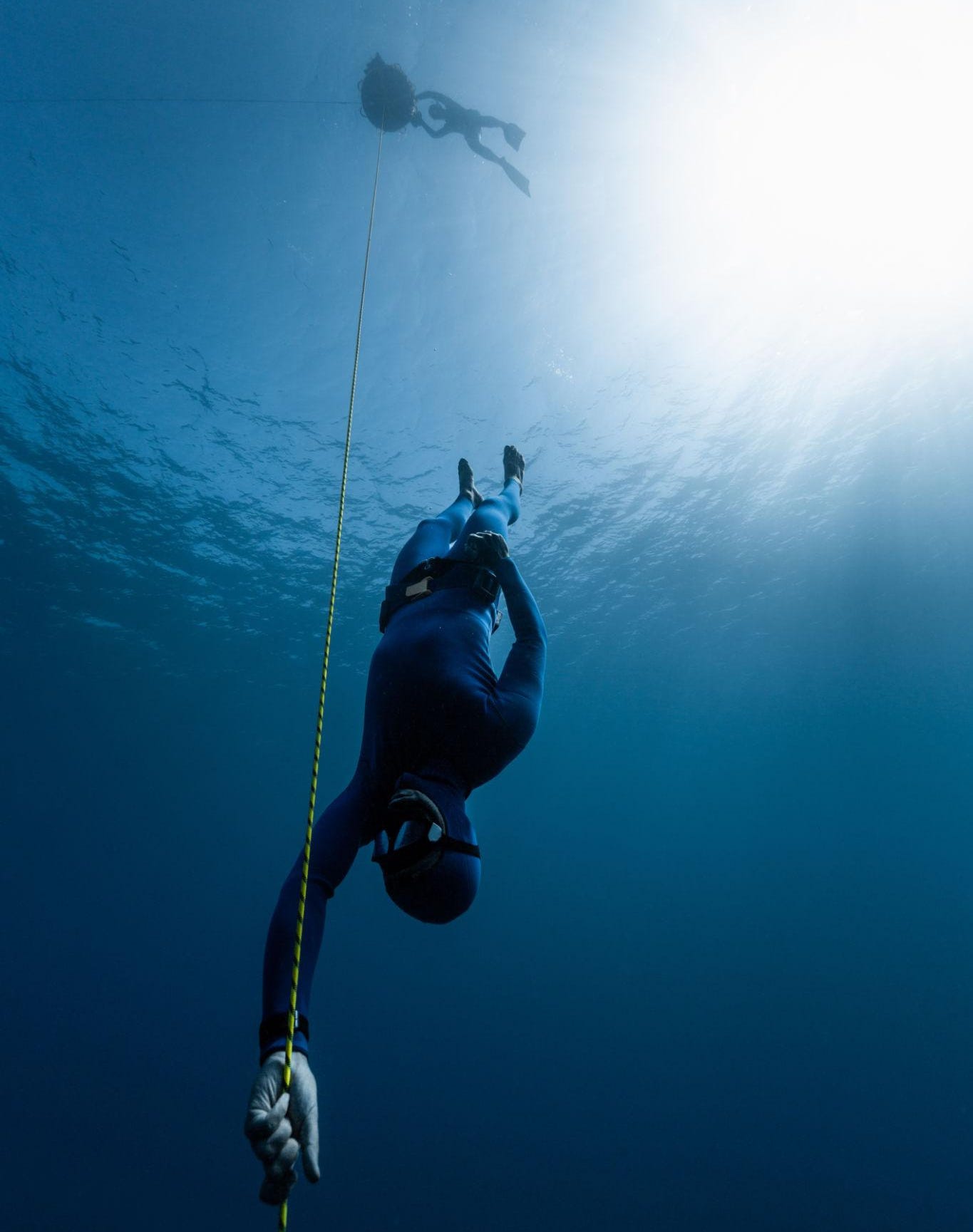
We dove. James was correct, as predicted. We were blown sideways as we tried to descend.
One | Two | Three | Four | Five | Six | Seven | Eight | Nine | Ten | Eleven | Twelve | Thirteen
Fourteen | Fifteen
This dive was nothing like the first one James and I had done. The current was so strong that the cylinder kept crashing into the D-ring, which was right over my hip bone. As I finned my way into the dark, I imagined the bruise I’d have that night. I had to kick hard against the current and hold tight to the shot line. Each of us wore a bailout tank side-mounted on our harnesses. I was afraid the extra weight would pull the bolt snaps free, but we made it to the sixty meter station intact. James unfastened the tank from my harness and clipped it to the deco line, one bolt snap at the top, and the other at the bottom to keep the tank from swinging. It hung like fruit near a little marker light attached to the rigging. This would orient in the dark us on the way up. We continued our descent.
I sighted Arnac and Jean-Louis away to my left, and I motioned to James. We swam down towards them and everyone signaled a ‘so-far-so-good.’ Once on the bottom, I was relieved to see that the silt had not been disturbed by the turbulence above. Each diver knew what they were supposed to be doing. James undid the other bailout tank and went about securing it. I was busy getting my camera ready, Arnac took out his measurement equipment and checked his dive computer. We were going in single-file, James first.
He attached the primary reel to secure a tie-off point on one of the heavy beams, acting as a reference for the exit path, and unreeled it tautly as he swam in. As per his instructions in the morning, we switched to frog kicks to minimize the silt lift. This was the real Minotaur’s cave, where anything could happen. I followed behind James, Arnac behind me, and Jean-Louis brought up the rear.
Our flashlights were pointing downwards and to both sides and the water clarity was good enough to capture images. I set to work, photographing the interior layout, while Arnac placed temporary markers. He took notes of the beam spacing, cargo hold width and frame positions. James, who continued to pay out the line, checked to make sure we were all behind him. He checked his dive computer to see if we’d reached our penetration limit, and he signaled a few seconds later to stop. For some reason, Arnac kept going. James signaled for him to stop, but he continued on. Had he not seen the signal to come back? James swam after him and they signaled each other, but I couldn’t see them from where I was. It looked like they were disagreeing about something. Then I saw James swim slowly back to his position. We all turned and followed the guideline. I could just barely make out the exit in James’s light. It seemed small and far away, with only enough room to clear beams and frames without banging into them with the camera housing. It reminded me of the trouble back at Cosquer, trying to maneuver my way through a crevasse.
As we passed a doorway, a current moving through the hull loosened a plank, and a fine cloud of silt started to rise. In a few seconds, visibility went from ten meters to about two. James switched his flashlight on and off to signal stop, as the cloud spread slowly. The push of the water made the guideline start to vibrate. It was hard not to feel panicked, and I struggled to hold position. James turned his headlamp down and signaled the team to dim theirs. It was time to practice the exit. I held on and forced myself to relax my jaw. Outside the wreck, we emerged one by one, exchanged the OK signals, and James signaled the ascent.
My heart was racing from the depth, but from the scare, too. We had nearly been caught in something like underwater “snow blindness,” which was probably what killed the divers in Cosquer. James swam up beside me as we ascended to the first deco station. It brought me out of my thoughts and back into the environment, which was a strange experience—as if I’d dozed off and been startled out of a light dream state.
We ascended together. James had dropped out of the leading position so we could talk, and now that we were closer to the surface, we could see Arnac and Jean-Louis off to our left. We each found the deco line and swam to the next stop, sixty meters, for about five minutes.
When we reached thirty meters we could talk.
—I can’t wait to get a look at this batch of photos, I said to James.
I wondered if my voice sounded as scratchy as his.
—I can’t wait to get up to the surface so I can have it out with Arnac.
—Yeah, I noticed all that. I was terrified that you guys would lift the silt.
—He wanted to keep going. Wasn’t my signal that we’d hit twenty meters clear enough?
—It was clear. I think this was deliberate.
—This is why I don’t like diving in teams over three.
—Yeah. Sadly, that’s not always up to you.
James tapped my arm and made the ascent sign, and we continued upwards. We had come to the nine meter level, what divers call the blue zone. This gave me plenty of natural light and a ten-minute stop. I remembered this stage from the first dive. The creatures at nine meters were varied. They often gather around deco lines and divers, curious and opportunistic. Today, I shot a cluster of Aurelia aurita, Moon jellyfish. Their translucent white bell shapes expanded and contracted hypnotically. It was a good moment to switch to video. There was so much to take in, that the time passed faster than I realized, and again we ascended.
In diving decompression, six meters is the sweet spot: it’s still deep enough to keep the gases from boiling into rapidly expanding nitrogen bubbles, but also shallow enough to breathe pure oxygen. It would flush the nitrogen and helium out quickly. This is why we would wait at this level for forty minutes. Enough time to take pictures and even goof around. We momentarily let go of the line, and I took a few shots of all of us. Arnac stood next to Jean-Louis, with his arm around the back of the CCR, and James joined in. Next, we did a four-face selfie with the deco line rising out of the top of the frame. Then I did individual portraits of each of us. These were going to be beautiful shots.
We were almost ready to go up, and after floating for so long in this stillness, I was feeling especially tired. I took James's hand and told him so, and he nodded. Then he broke eye contact with me and frowned at something below us. The deco line was shaking. I looked down and saw Arnac moving his head strangely, hands to his jaw, as if he were trying to shake off a sudden wave of vertigo. James asked him how he was, and he said he was dizzy and nauseous.
—Steady, man. I’m going to switch your gas. You’ll be okay in a moment.
Arnac started to drift upward and James had to grab him and pull him back to the line. Trapped gas in his suit was making him increasingly buoyant, something he could not control, and if he floated too high before completing his stops, the consequences could be serious.
—Hang on to the line! I think your suit isn’t venting right. Raise your shoulder.
Arnac did this, and a stream of bubbles escaped from his suit. He stopped drifting and got hold of the shot line. James asked how he felt, and Arnac said that the dizziness had passed. He patted Arnac’s shoulder and signaled that we could swim to the surface. I was glad Arnac was okay, but I couldn't stop thinking about the way he had ignored James’s signal.
❈
Guys, the last two chapters are coming.
Brace yourselves.
Everything the novel has been building toward since the prologue happens from here. Thank you to everyone who's been reading, commenting, and making the journey with Robert, Stephanie, James, and Philippe.
See you underwater one last time, July 8.
The last dive! Oh no....! I love the deep dive scenes. Especially on a sweltering hot day where I'm stuck on land.