
The Wreck Diver · Chapter 17
Karim al-Muhtadi

I’d had such a run of good luck with this project that I was anxious to leave nothing unexplored.
One | Two | Three | Four | Five | Six | Seven | Eight | Nine | Ten | Eleven | Twelve | Thirteen
Fourteen | Fifteen | Sixteen
I waited impatiently for the call slip to be filled and in the meantime, I reworked a section of text I had started the day before. Eventually, I heard the sound of the metal book trolley approaching, and a librarian handed me the log that fit the dates of a captain who had once sailed under Uluç Ali, but whose name I had yet to discover. It was covered in plain black calfskin and had thick pages. I was surprised at how legible the captain’s handwriting was, and then I was not, because clearly, this was a man of precise thought, and his script was tight and disciplined. I was transported to the Mediterranean of the early seventeenth century. There was mention of several prizes, attacks, and sinkings of Christian vessels. His descriptions were bold and stark, and sounded eerily like Hemingway’s war correspondence.
I had been reading for an hour and a half when I found mention of Karim al-Muhtadi. It had to do with a promotion. I turned the page and the script was now from another hand. It was not as easy to read, but I saw another mention of a Karim. This time the surname was al-Nasrānī, Karim the Christian. I found two commendations dated a few months apart. One was for Karim al-Muhtadi and told the story of a man falling between ships as the boarding party crossed to the Italian vessel under attack. Karim exposed himself to the line of fire to rescue the man as he clung to the hull. Ali used the word شجاع, shujāʿ, brave, in describing Karim’s actions. There was a second about Karim al-Nasrānī being recommended as a squad leader of the ‘dagger-men’ that would use the cover of night to dispatch the commanding officers on board a Venetian merchant vessel. He also noted that it had been six months since his behavior had abruptly changed, and that he was beginning to see he had the makings of a leader. But there was one further remark that electrified me: ‘I suspect this great change is because he is now married. Saima is a good woman. I was right to accept her request that I be her wali1.’
This was as unexpected as it was extraordinary. It was the stability he had never had. The captain would have been an important part of his social life, and Philippe a welcome member of a new family. The promotion must have made him feel for the first time in his life that he had a promising future. I had a sudden flash of irony that in turning over a new leaf, with his promotion and the change in his sentimental life, Philippe had accidentally sealed his own doom. Nevertheless, his path reinforced something I already knew: corsairs were not outlaws; they were more like state-sanctioned privateers under Ottoman authority, and this was an advantage to my research. Had Philippe married some Marseillaise, it would probably have been a common-law arrangement. I was hoping to find out something more about Saima, but I only had her given name, and this, I had to admit, went beyond my research duties as far as the wreck was concerned. I had now reconstructed the whole arc of the conversion story. It was time to go back to France.
Amir, whom I met for lunch once more that week, insisted on driving me to the airport. It was the kind of gesture I had come to see was natural among Algerians, and I appreciated it. I had to fly a lot, but as Steph never tired of teasing me about, I really hated it. Amir’s kindness made the trip back a little more tolerable. Back at the Hôtel Amista, I unpacked and called Steph, but it was too early in the day. She would be out on the research vessel in a meeting, or already in the water. Having taken the earliest flight of the day back to Marseille, I had the whole day ahead of me, and I knew where I had to go.
Toulon was my first choice, the Service Historique de la Défense, only an hour away, whose naval archives were not vast but might suffice. I reasoned the records I needed were more likely to be there than in Paris, which of course, had much more material. I certainly wouldn’t mind going to Paris, but it might not be necessary.
In the early 1600s, the French were still more than fifty years away from having a standing navy. The squadrons that chased Karim al-Muhtadi across the Mediterranean belonged to the Corps des galères. I haven’t said anything about this so far, but it’s an engaging part of the story. These were the galleys of neither private citizens nor men of the watch, but royal vessels, commanded by noble officers of the French crown. The capitaines de galère were appointed by the Grand Maître des Galères, who at the time was Philippe-Emmanuel de Gondi, under Henry IV, and here I had to be careful not to go down this rabbit hole because I would surely not accomplish the day’s work before closing time.
Aside from this, the battles recorded here were engrossing in and of themselves. Now I could search directly for the Marie-Caroline, and I soon found what I needed. The account of the skirmish, the sinking, and the capture of thirty Maghrebi corsairs, among them Philippe Le Boutillier dit ‘Philippe La Fripouille et Karim al-Muhtadi al-Faransi,’ the convert and Frenchman. This was it. My hands trembled faintly, as if I’d drunk too much coffee. The dossier they brought me had everything. I emptied it onto the thick wooden table and stared at the documents.
Philippe-Karim was in command of a xebec in hot pursuit of the Marie-Caroline. They had already boarded her when three French patrol galleys appeared. Knowing that the enemy was too strong to defeat, he sank the merchant vessel and the xebec tried to escape under sail. Even though xebecs are light and fast, the galleys closed the distance. Having sail and oars, they could maintain their speed regardless of the wind. They fired bow cannons, destroying the main mast and killing much of the crew. The first of the galleys to reach her launched its soldats de marine across the rail. Some corsairs were captured, Philippe among them. Officially, this was all I was required to confirm, and I could have ended my research at this point. Nevertheless, I again felt compelled to hear out the whole story of Philippe’s demise.
Le Procès de Philippe Le Boutillier, his trial: even though the ministry was paying me to investigate the precise nature of the sinking of the ship, I would start here. The first segment was devoted to assassinating his character. His prior misdeeds in Marseille were read out, and it was noted that ‘the accused refuses to answer certain questions.’ Once a composite of his moral unworthiness had been constructed, the prosecution moved on to establishing his apostasy. Here La Fripouille stated ‘in a clear and unequivocal tone’ that he had no allegiance to France and was in the service of the corsairs of Algiers. Again he refused every question put to him, even when it was prefaced with the phrase ‘On pain of death.’ He was accused of piracy, treason and apostasy. When asked how he pleaded, he said nothing. The prosecutor rewords the question more aggressively and Philippe shouted something in Arabic, which was neither understood nor recorded with any precision. The judgement was swift: execution by hanging.
At this moment, the warning tone sounded in the hall, and I realized I would have to return the next day for the account of the battle and sinking of the ship, and I would remember it as one of the most important days of my career. I had just enough time now to finish what I was reading.
This was an account of the hanging, one I had never seen before. It was a consular report that gave me the closure I wanted. It was not easy to stomach, but my fortitude had paid off. Attached to the report, was a severely distressed document made of what looked like Italian rag paper, and was written in the wide, loopy Arabic script I had come to identify as Maghrebi. There was a dark, brown smudge on the left margin, a thumbprint, and other brown smudges of various shades scattered across the page. Blood? I translated the text. It was, of all things, a poem.
Let the seasons turn against us,
they cannot bury what was sown.
Wind may scour the hills,
the root remains in the stone.
Sorrow and hunger have sat with us;
they did not take our bread.
What we endured became our song,
and the song did not break.
It did not sink into darkness,
nor wander beyond the sky.
What was given between us
stands where it was placed.
It was signed, Saima.
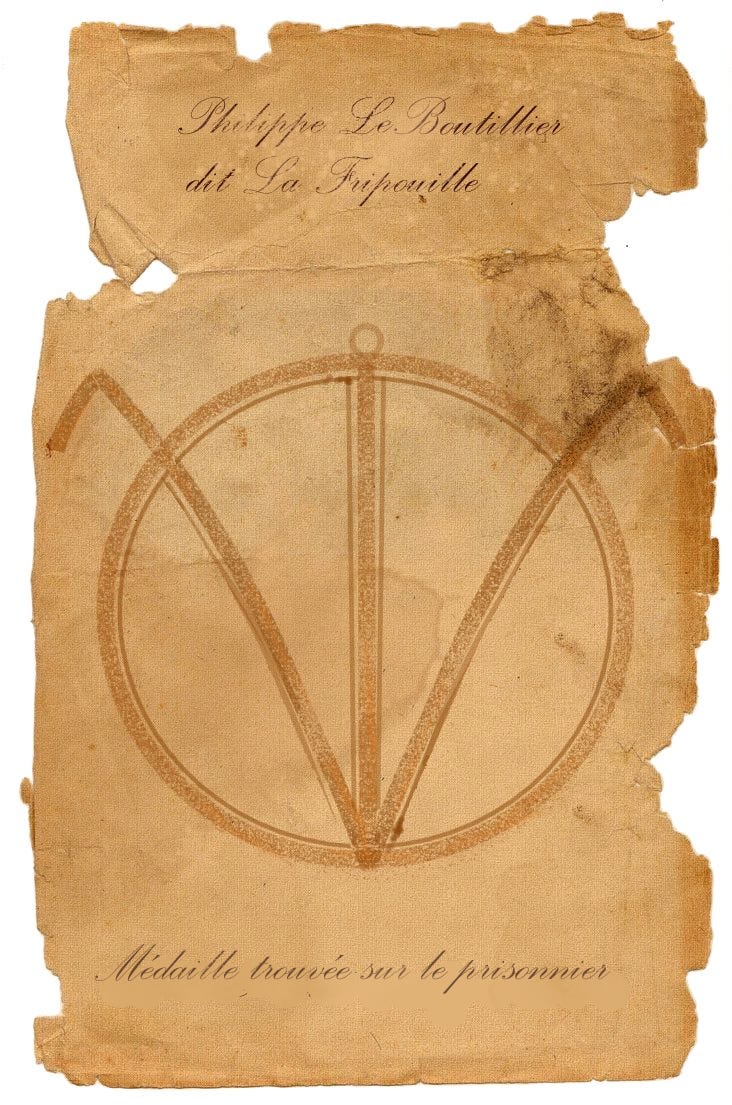
The consular report mentioned that the bailiff found two artifacts on Philippe when he was cut down: the poem in a pocket of his clothes, and in his mouth a small round medal, ‘hidden to prevent confiscation.’ I would have gone anywhere to find that medal, but the documentation included a line drawing of it—what I later learned was the Berber Tizizwit, an ancient symbol of community, blessing (baraka), and health.
Found on his body. Perhaps parting gifts from wife to husband. A likely supposition I would never get to investigate.
❈
In the customs of matrimonial guardianship, the wali (guardian) has sole authority with respect to the marriage of a healthy, mature female ward if she is a virgin.
Nice visual too!!!